
symbol barcode scanner ls2208 manual
The Symbol LS2208 is a widely-used, reliable 1D barcode scanner, detailed in extensive online manuals and quick start guides available as PDF downloads.
Motorola/Zebra provides comprehensive documentation, including Russian-language versions, for setup, programming, and troubleshooting this popular device.
Overview of the LS2208
The Symbol LS2208 is a handheld, single-line laser scanner renowned for its speed and reliability in retail, healthcare, and light industrial environments.
Numerous online resources, including downloadable PDF manuals and quick start guides, detail its functionality. These guides, available in multiple languages like Russian, cover everything from initial setup to advanced programming via barcode sheets. It’s a cost-effective solution for 1D barcode scanning needs.
Key Features and Benefits
The LS2208 boasts rapid scanning speeds and a comfortable, ergonomic design, enhancing operator efficiency. Detailed in readily available manuals, its key benefit is ease of integration via keyboard wedge, serial, or USB interfaces.
Programming is simplified using barcode sheets, allowing for quick customization. Its robust build and affordability, as highlighted in online documentation, make it a valuable asset.
Unboxing and Initial Setup
Initial setup, as outlined in the user manual, involves verifying package contents and connecting the scanner via the chosen interface – serial, USB, or keyboard wedge.
Package Contents
Typically, the LS2208 package includes the barcode scanner itself, a quick start guide for immediate use, and interface cables appropriate for the selected connection type – serial (RS-232) or USB.
While not always included, some bundles may contain a mounting bracket for fixed positioning. Refer to the specific documentation accompanying your purchase to confirm all included items, as variations exist.
Connecting the Scanner
Connecting the LS2208 involves selecting the appropriate interface – keyboard wedge, serial (RS-232), or USB – based on your system’s requirements. Ensure the host device is powered off before connecting the cable.
Securely attach the cable to the scanner and the host. Programming may be needed to configure the interface correctly, utilizing barcode programming sheets detailed in the user manual.
Powering On the Device
The LS2208 is typically powered via the connected interface – USB or serial port – drawing power directly from the host system. No separate power supply is generally required for standard operation.
Once connected, the scanner should power on automatically. If not, verify the cable connection and host system power. Refer to the manual for troubleshooting power-related issues.
Understanding the Scanner Components
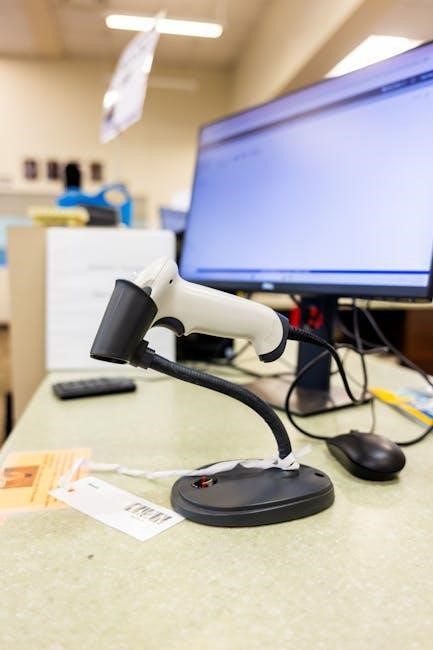
The LS2208 features a scanning window, indicator lights, and connection cables. Manuals detail each component’s function for optimal performance and maintenance.
Understanding these parts aids in troubleshooting and proper usage of the barcode reader.
Scanning Window and Illumination
The LS2208’s scanning window is crucial for reading barcodes efficiently. Maintaining a clean window ensures accurate reads, as detailed in the user manual.
Its illumination system projects a visible laser or LED light, depending on the model, to effectively scan various 1D barcodes. Proper alignment with the barcode is key, and the manual provides guidance on optimal scanning distances and angles for reliable performance.
Buttons and Indicators
The LS2208 typically features minimal buttons, often just a trigger for initiating scans. The user manual explains the function of any present buttons.
LED indicators provide visual feedback on the scanner’s status – power on, successful read, or error conditions. Understanding these indicators, as outlined in the documentation, is vital for quick troubleshooting and efficient operation.
Cable Connections
The LS2208 supports various interface options, including keyboard wedge, RS-232 serial, and USB. The manual details the pin configurations for each cable type.
Proper connection is crucial for data transmission. Instructions cover securely attaching the appropriate cable to the scanner and host system, ensuring reliable communication as described in the provided guides.
Basic Operation
The LS2208 efficiently scans 1D barcodes; proper technique, as outlined in the manual, ensures successful reads with clear audio and visual confirmation.
Scanning Techniques
Optimal scanning with the LS2208 involves presenting the barcode squarely to the scanner window, maintaining a comfortable distance, and utilizing a steady motion.
The manual emphasizes avoiding angled presentations or excessive speed, as these can hinder accurate decoding. Experiment with slight adjustments to distance and angle for challenging barcodes, ensuring the illumination fully covers the code.
Consistent technique, as detailed in the provided guides, maximizes first-pass read rates.
Reading Different Barcode Types (1D)
The LS2208 excels at reading standard 1D barcodes, including UPC/EAN, Code 39, Code 128, and Interleaved 2 of 5.
Default settings support common symbologies, but the scanner’s programming mode, accessed via barcode sheets, allows enabling or disabling specific types.
Manuals detail barcode codes for customization, ensuring optimal performance with diverse 1D barcode formats encountered in various applications.
Successful Scan Indication
Upon a successful scan, the LS2208 provides clear feedback to the user. Typically, this includes a distinct audible “beep” tone and a visual indication via the scanner’s LED indicator light.
The user manual details potential error beeps, signifying issues like poor barcode quality or unsupported symbology.
Proper scan indication confirms data capture, streamlining operations and minimizing errors in data entry processes.

Programming the LS2208
The LS2208 is programmed using barcode programming sheets found in the user manual, allowing customization of settings like symbology and interface configuration.
These sheets simplify adjustments without direct hardware access.
Accessing Programming Mode
To enter programming mode on the Symbol LS2208, scan the “Enter Programming Mode” barcode located within the official user manual (available as a downloadable PDF);
This barcode initiates a special configuration state, enabling the scanner to accept programming commands via subsequent barcode scans. Ensure the scanner is properly connected before attempting this process, as detailed in setup guides.
Following this, scan the desired programming barcodes.
Using Barcode Programming Sheets
Programming the LS2208 is primarily achieved by scanning specific barcode “codes” found in the user manual’s programming section, often presented as sheets within the PDF document.
These barcodes represent commands – enabling/disabling symbologies, altering data transmission, or resetting to factory defaults. Scan them sequentially to configure the scanner to your specific needs, following the manual’s instructions carefully.
Default Settings and Resetting
The LS2208 ships with pre-configured settings optimized for common applications, detailed within the user manual. However, if customizations cause issues, a reset is possible.
Scanning the designated “reset to factory defaults” barcode, found in the programming section of the PDF manual, restores the scanner to its original configuration, resolving many operational problems quickly and efficiently.

Interface Configuration
The LS2208 supports keyboard wedge, serial (RS-232), and USB interfaces, each requiring specific configuration via barcode programming sheets detailed in the manual.
Keyboard Wedge Interface
Utilizing the keyboard wedge, the LS2208 emulates a keyboard, transmitting scanned data as keystrokes to the host computer. Programming for this interface, as outlined in the manual, involves configuring parameters like suffix and prefix characters.
This method requires no software installation, offering broad compatibility, but careful configuration is crucial to avoid unintended data entry or system conflicts, detailed within the provided documentation.
Serial Port (RS-232) Configuration
For RS-232 connectivity, the LS2208 manual details configuring baud rate, data bits, parity, and stop bits for proper communication. Programming involves scanning specific barcodes from the programming guide to set these parameters.
Correct serial port settings are vital for reliable data transmission; incorrect configurations can lead to garbled data or communication failures, as explained in the documentation.
USB Interface Configuration
The LS2208 often functions as a USB Human Interface Device (HID) requiring no driver installation for basic keyboard wedge operation. However, the manual notes that some systems might benefit from utilizing available drivers.
Configuration typically involves simply plugging in the scanner; advanced settings, if needed, are programmed via barcode sheets, mirroring the RS-232 process.
Troubleshooting Common Issues
The LS2208 manual details solutions for scanning failures, connectivity problems, and error beeps, often resolved through programming barcode adjustments or cable checks.
Scanner Not Reading Barcodes
If the LS2208 fails to read barcodes, the manual suggests verifying the barcode symbology is enabled via programming mode using barcode sheets.
Ensure proper scan distance and angle, and confirm the barcode isn’t damaged or poorly printed. Check for obstructions in the scanning window and consider a factory reset if issues persist.
Connectivity Problems
When facing connectivity issues with the LS2208, the manual directs users to confirm the correct interface (Keyboard Wedge, Serial, or USB) is selected and configured properly.
Verify cable connections are secure, and check the host system’s port settings. Serial port configuration requires careful attention to baud rate, parity, and data bits.
Scanner Beeping Errors
The LS2208 utilizes beeping patterns to indicate errors, as detailed in the user manual. These audible signals can signify issues like unreadable barcodes or programming errors.
Consult the manual’s beep code chart to decipher the specific error. Common causes include incorrect symbology settings or a faulty connection, requiring troubleshooting steps.

Maintenance and Care
Regular cleaning with a soft cloth is recommended, as outlined in the LS2208 manual. Proper storage and preventative measures ensure long-term reliability.
Cleaning the Scanner
To maintain optimal performance, the LS2208 scanner requires periodic cleaning. Use a soft, dry cloth to wipe the exterior housing and the scanning window. Avoid harsh chemicals or abrasive cleaners, as these can damage the plastic components or the sensitive optical elements.
Ensure the scanner is disconnected from power before cleaning. Gently remove any dust or debris from the scanning window to ensure accurate barcode reading. Regular cleaning extends the scanner’s lifespan.
Storage Guidelines
When not in use, store the Symbol LS2208 scanner in a clean, dry environment. Avoid exposure to extreme temperatures, humidity, or direct sunlight, which can negatively impact its performance and longevity. Protect the scanning window from scratches and dust by using a protective cover.
Disconnect the scanner from any power source during storage. Proper storage ensures the device remains functional and reliable when needed for future operations.
Preventative Maintenance
Regular cleaning is crucial for maintaining optimal performance of the Symbol LS2208. Periodically wipe the scanner with a soft, damp cloth to remove dust and debris, especially the scanning window. Avoid abrasive cleaners or solvents.
Inspect the cable connections for damage and ensure they are secure. Proactive maintenance extends the scanner’s lifespan and minimizes potential operational disruptions.

Advanced Configuration Options
The LS2208 allows customization via barcode programming sheets, enabling symbology control, data formatting adjustments, and transmission delay settings for tailored operation.
Symbology Enable/Disable
The LS2208’s functionality can be refined by selectively enabling or disabling specific barcode symbologies. Utilizing barcode programming sheets – downloadable from the official Motorola/Zebra website – users can precisely control which 1D barcode types the scanner will attempt to decode.
This customization optimizes scanning performance, reducing errors and improving efficiency by focusing on the symbologies relevant to the specific application. Detailed instructions are found within the user manual.
Data Formatting Options
The LS2208 offers data formatting capabilities, allowing modification of scanned data before transmission. Programming sheets enable users to add, delete, or rearrange characters, and implement prefixes or suffixes. This is particularly useful for integrating with specific software or databases.
These options, detailed in the user manual, ensure data compatibility and streamline workflows, customizing output to meet precise requirements without altering the original barcode information.
Transmission Delay
The LS2208 allows adjustment of the transmission delay, controlling the time between a successful scan and data transmission. This feature, configurable via barcode programming sheets, addresses potential communication issues with host systems.
Adjusting the delay can resolve conflicts or ensure proper data reception, particularly in environments with slower processing speeds or complex network configurations, as outlined in the scanner’s manual.

Safety Information and Laser Specifications
The LS2208 is a Class 1 or Class 2 laser product; avoid staring into the beam, per documentation. Regulatory compliance details are found within the manual.
Laser Class and Safety Precautions
The Symbol LS2208 is categorized as either a Class 1 or Class 2 laser product, depending on the specific model and region. Crucially, direct exposure to the laser beam should be avoided; never stare directly into it.
The manual emphasizes these safety precautions to prevent potential eye damage. Always operate the scanner according to the guidelines provided in the official documentation to ensure safe and responsible use.
Regulatory Compliance
The Symbol LS2208 barcode scanner adheres to various regulatory standards to ensure safety and electromagnetic compatibility. Documentation confirms compliance with applicable rules, though specific certifications may vary by region and model.
Users should consult the full manual for detailed information regarding these standards, ensuring the device operates within legal and safety guidelines in their specific location.
Laser Beam Characteristics
The Symbol LS2208 utilizes a Class 1 or Class 2 laser, depending on the specific configuration, as indicated on the device and in the user manual.
Directly staring into the laser beam is explicitly cautioned against, particularly with Class 2 lasers. Documentation details wavelength and power output, emphasizing adherence to safety precautions during operation and maintenance.
Technical Specifications
The LS2208’s specifications, detailed in the manual, cover physical dimensions, electrical power needs, and operational environmental limits for reliable performance;
Physical Characteristics
According to the user manual, the Symbol LS2208 barcode scanner boasts a compact and durable design. It measures approximately 6.1 inches (15.4 cm) in length, 2.7 inches (6.9 cm) in width, and 4.3 inches (10.9 cm) in height.
Weighing around 14.4 ounces (408 grams), its robust construction ensures longevity, even with frequent handling in demanding environments, as detailed in the provided documentation.
Electrical Specifications
The LS2208 scanner operates with a 5 VDC input voltage, consuming typically 2.5 Watts during normal operation and a maximum of 4.0 Watts.
Its current draw is around 500mA. The device is designed for standard power adapters and interfaces, ensuring compatibility with various systems, as outlined within the official user manual documentation.
Environmental Specifications
The LS2208 barcode scanner is designed to withstand a broad operating temperature range, from 32°F to 104°F (0°C to 40°C).
It can also endure storage temperatures between -4°F to 140°F (-20°C to 60°C). Humidity ranges from 5% to 95% non-condensing, ensuring reliable performance in diverse environments, as detailed in the product manual.

Warranty Information
The LS2208 typically includes a standard warranty covering defects in materials and workmanship. Contact Zebra/Motorola support for specific coverage details and claim procedures.
Warranty Coverage
Zebra’s warranty for the LS2208 barcode scanner generally covers defects in materials and workmanship under normal use. This doesn’t include damage from misuse, accidents, or unauthorized modifications.
Warranty periods vary based on region and purchase date; checking the official documentation or contacting Zebra support is crucial for precise details regarding your specific unit’s coverage duration and limitations.
Contacting Support
For technical assistance with your Symbol LS2208, the primary resource is the official Motorola/Zebra website. There, you’ll find FAQs, downloadable manuals, and potentially a support ticket submission system.
Direct contact options, like phone numbers or email addresses, may also be listed on their site, depending on your region. Refer to warranty information for specific support channels.
Resources and Downloads
Access the official Motorola/Zebra website for the LS2208 user manual in PDF format, alongside potential firmware updates to optimize scanner performance.
Quick start guides are also readily available for immediate setup and operation assistance.
Official Motorola/Zebra Website
Visit the official Motorola/Zebra website – specifically www.motorola.com/ls2208 – to locate the most current and comprehensive resources for your LS2208 barcode scanner.
Here, you’ll find downloadable user manuals, programming guides (including barcode sheets for customization), and potentially updated firmware to enhance functionality and address any known issues. This site is the primary source for official support.
LS2208 User Manual (PDF)
A detailed LS2208 User Manual is readily available in PDF format online. These manuals, often exceeding 342 pages and 2MB in size, provide exhaustive instructions for all aspects of the scanner.
From initial setup and operation to advanced programming techniques and troubleshooting, the PDF manual serves as a complete reference guide for maximizing the scanner’s capabilities and resolving potential issues.
Firmware Updates
While information regarding firmware updates for the LS2208 is less prominently featured in readily available documentation, checking the official Motorola/Zebra website is crucial.
Regularly reviewing the support section can reveal available updates designed to enhance performance, fix bugs, or add compatibility with new barcode symbologies, ensuring optimal scanner functionality.